Dedicated to the memory of K. H. Scheer and Walter Ernsting, who first gave us Perry Rhodan in 1961 and of Forrest J and Wendayne Ackerman, who first brought his adventures to the United States in 1969.

Saturday, October 22, 2011

Perry Rhodan #14, Venus in Danger (1972)


By Kurt Mahr (= German issue #20, 19 January 1962)


First, a couple of words. Welcome back to what I intend to be the leaner and hopefully meaner Perry Rhodan Reading Project blog. Several things have kept me away from this for the past several months: A busier than usual summer – followed by a significantly busier than usual fall semester; The other blog I started back at the beginning of the summer because I do read much more than just Perry Rhodan, and I found myself wanting a forum through which to share my reading experiences on all that other stuff as well; The fact that I did reach a good place to take a break; And finally, the fact that I tend toward a certain degree of obsessive compulsiveness that had me adding more and more detail to the recaps that I was doing for the past few Perry Rhodan books, to the point that the whole thing became more a chore than a hobby. That last is something I constantly fight against on the other blog as well.

But I'm back now, and hopefully if I can restrain myself from going overboard with my individual entries I can maintain more of a steady pace. The most immediately apparent difference between my more recent (?) entries is that I'm abandoning the chapter-by-chapter summaries in favor of a more general synopsis of the story as a whole. The other commentary will be basically just whatever comes to me – as it always was – with no effort at full-scale annotation. Maybe that will be more manageable, because frankly I've been hankering to get back into the saga for some time … but dreading sitting down to write it up as well.

Anyway, let's look at this book …
* * *
Hypertransitioning back into the solar system, Perry Rhodan and the crew of the Stardust II establish contact with Col. Freyt in Galacto-City – only to find that over four years have passed since they departed and began their adventures in the Vega System culminating in the quest for the planet Wanderer where Rhodan met the mysterious, almost godlike intelligence It and was granted a form of immortality that nonetheless requires him to return to Wanderer every sixty-odd years or so. From his and his companions' own perspective it has been only a few months. In those years of Earth-time, however, the fragile beginnings of Terran unification that Rhodan had brought about have begun to break down, with the Eastern Bloc attempting to reassert itself as an independent, even dominant power. The danger of a third world war has resurfaced. As they move through the solar system toward the Earth, the perplexed returnees detect a large number of small vessels approaching and landing on Venus. Needing to use the great Arkonide robot brain in the ancient base on that world to plot out the orbit of Wanderer for their eventual return, Rhodan diverts toward Earth's sister planet.

Approaching Venus, they are attacked by a nuclear missile – which of course has little effect against the advanced defenses of the Arkonide battlesphere. Racing low above the surface of the jungle planet at an incredible nine miles per second, the Stardust effectively becomes a fireball that inadvertently decimates the just-deployed forces of the Asian Bloc, who have been sent to secure the Arkonide technology of Venus Base for that government. Approaching Venus Base, the Stardust is suddenly stopped cold by the base's defense screens – and Rhodan realizes that his previous command to the robot brain contained a fatal flaw. His reprogramming the positronic brain to allow humans access had almost allowed the invading Easterners access – which was only averted by the “dangerous and unusual” situation created by the nuclear detonation that has now caused the base to go into total lockdown such than even Rhodan himself cannot get in without demonstrably averting the dangerous situation first!

The bulk of the story thereafter is the tale of how Rhodan balances the need to eliminate the threat posed by the surviving Eastern Bloc forces with his wish to avoid unnecessary bloodshed, alternating with the trek of those Eastern Bloc forces – mainly focussing on General Tomisenkov who ends up separated from his comrades – across the hostile jungle terrain of Venus where they face a variety of monstrous threats that include giant dinosaur-like creatures of various types including pterodactyls in addition to storms that out-strip the worst Terran hurricanes. Eventually Rhodan and his men round up most of the Easterners (except for Tomisenkov and a few of his men who remain at large, albeit now without ships or the means to threaten Rhodan or the base) and sufficiently demonstrate to the robot brain in charge of the Arkonide base that the “dangerous and unusual” situation has been neutralized. That news is conveyed by mutant teleporter Tako Kakuta, who jumps through the force field, allowing himself to be captured by the robots so that the sophisticated computer can read it directly from his mind.

Once inside the base, Rhodan sets the brain to the task of calculating the orbit of Wanderer – just in time. Had only a day or two more passed, the coordinates of vanishingly small arc of the orbit that they had plotted would have been too out-of-date for even the great robot intelligence to extrapolate with any accuracy. His ability to return to Wanderer assured, Rhodan announces to Reginald Bell his new resolve: “I think we've shown patience long enough. … If the people of Earth haven't the sense, the will, the ability – if they don't want to be united – they'll have to be for their own good. We can't afford to move out into the universe with the threat of disunity at our back. We must make a clean sweep and we'll start with the troublemakers” (p. 105).

(Another synopsis may be found at http://perryrhodan.us/php/displaySummary.php?number=20 )
* * *
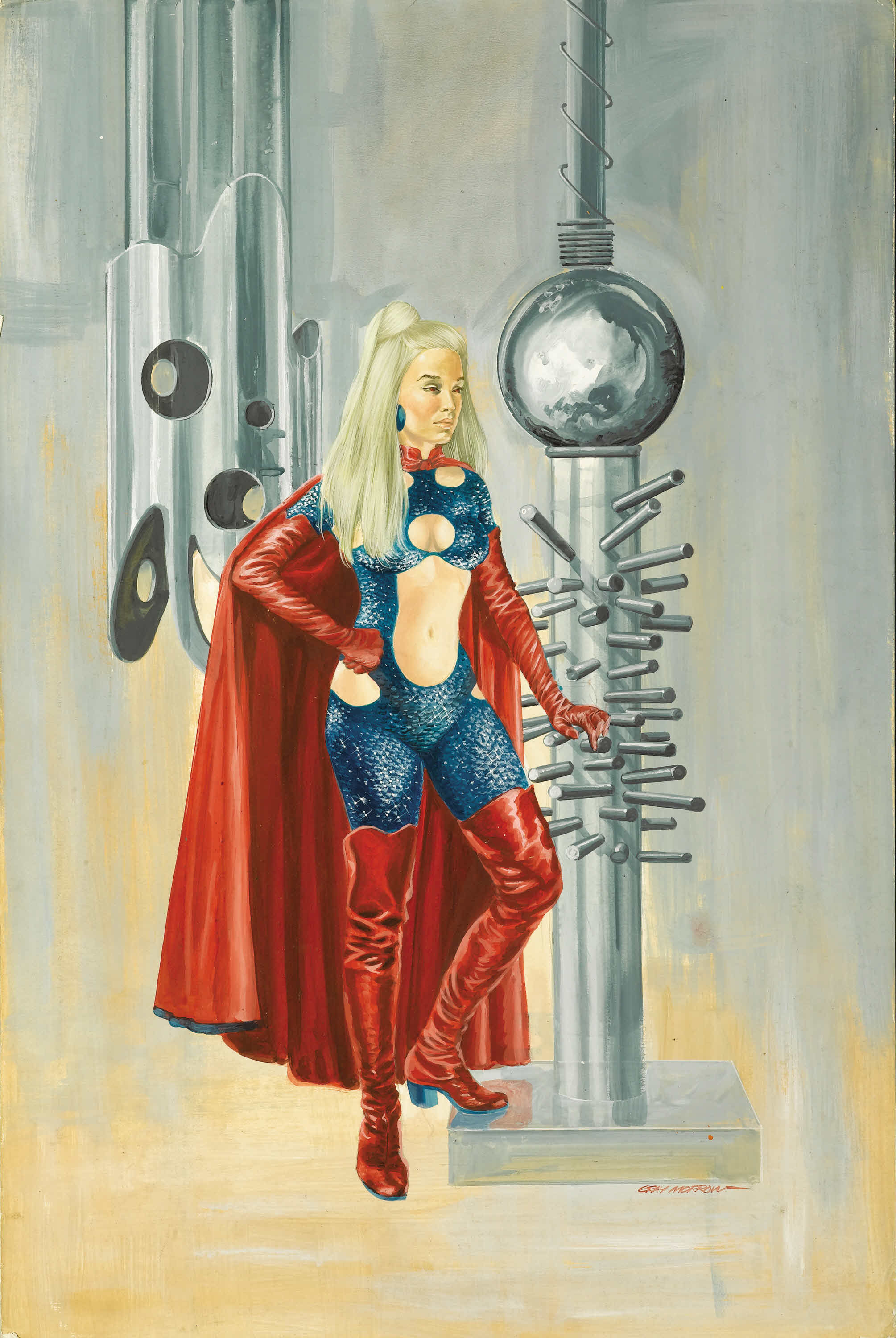
From here on out, all the way down until after #100, the Ace edition covers will be painted by Gray Morrow.

This volume has the usual editorial, which “the Captain of the Stardust 4E” gives over to a German fan's letter that drops hints of storylines to come; a short tribute to “Pucky's Papas,” i.e. Walter Ernsting who went by the pen-name of Clark Darlton; an announcement of a slight change in the format of the “magabooks” starting with the next issue, consisting of a page increase to accommodate backup short stories and serial chapters; “Scientifilm World” commenting on an ambiguity as to what Klaatu's actual words are at the end of The Day the Earth Stood Still; the “Perryscope” letters column, subscription information; and a couple of very low quality photographs that I can't even get a decent scan of. The first of these is of a gentleman in a sport coat perched debonnairely atop the fender of an automobile beside a small stuffed animal that may be a mousebeaver … is that Walter Ernsting/Clark Darlton with a Pucky-doll? It doesn't really look like other pictures I've seen of Ernsting, but those were from later in life. The second picture is from The Day the Earth Stood Still.

Other than those two photos there aren't any interior illustrations.

Besides Rhodan's reprogramming of the Venus Base positronic brain having some unintended consequences, so do the “orders” he had left Freyt with in command of Galacto-City. Wishing to head off any temptation that Freyt might have to use Arkonide techology for his own political benefit in Rhodan's absence, he had left him under a hypnotically-enhanced inhibition against interfering in Terran politics – which left him impotent as the situation deteriorated and Eastern Bloc ambitions led to escalating political instability. Rhodan chastises himself pretty roughly for his lack of imagination in both cases – neither imagining that another Earth power might attempt to invade Venus, nor that there might develop a situation in which Freyt might have a legitimate need to deploy the power of Arkonide technology – and announces to Bell his intention to consult more closely with the positronic brain in future because of its dispassionate nature and lack of preconceived notions.

Why can't Tako Kakuta teleport into the base from the beginning? I think it's because there was the necessity that his mind be clear on the fact that the dangerous situation had indeed been averted. Had the positronic brain detected subterfuge or deceit, the result may have been worse than the situation that had developed.

I've commented on this before, but Kurt Mahr seems to have been the series' go-to writer for describing humans pitted against hostile alien worlds, their monstrous animals and environments. He of course wrote #4(b) Base on Venus, #10 The Ghosts of Gol, and #11 The Planet of the Dying Sun. There's a lot of similarity of mood among these stories – particularly between this one and Base on Venus for obvious reasons.

Pucky is noticeably absent in this story, but I didn't miss him. Thora is still sulking in her quarters, unseen since the crushing disappointment of the Unknown Immortal denying the decadent Arkonides the goal of their quest that had brought them to this part of the galaxy in the first place, bestowing effective immortality on the “primitive barbarian” Perry Rhodan instead.

When exactly did the Stardust II jump forward in time? There was no indication that anything was amiss at the end of the previous book when they returned from Wanderer to the Vega System. So it would have had to have been in during the jump from there back to the Solar System, right? Is it ever explained? And, even though Freyt was under orders to keep hypercomm silence, why didn't whomever Rhodan left in the Vega System start wondering why Rhodan's jump back to Earth at the very end of the previous book was then followed by no contact whatsoever for years? Surely they weren't expecting that. Why did they not try contacting Freyt in Galacto-City?

Title of the first chapter: “Lost – One Lustrum!” The term doesn't appear in the text of the story, not surprisingly since it's not a word that is in very common usage. The chapter titles that have appeared since #6 and the beginning of the one-story-per-book “magabook” phase of the English edition are, it's my understanding, products of Forrest J. Ackerman's fevered mind. On the evidence of the many puns that appear in his various editorials and letter column comments, he obviously had a great love for words … although the results could be quite painful. “Lustrum” is actually a Latin term, meaning a five-year period. I don't know that I've ever heard it used in “real-life” conversation – although I must confess I drop it on my students from time to time in its proper historic context just to see if they'll ask me what it means. A lustrum was specifically the five-year period between censuses under the old Roman Republic. I don't remember in which of his many books it was, but I do know to what author I owe that little piece of odd knowledge – Isaac Asimov. More than just a science fiction writer, Asimov wrote many works of popular history and religious/literary commentary as well (e.g., Asimov's Guide to the Bible, albeit from a thoroughly secular humanist perspective), and for much of my teenage years I voraciously plowed through as much of that as I could get my hands on. Although I liked his science fiction – especially the Foundation trilogy as The Fall of the Roman Empire-recast-in-space – those other works probably made more of an impression on me and probably helped instill in me the love of history that eventually led me into my career. But I wonder how many readers way back when went scurrying for their dictionaries looking for "lustrum" – or needed to whether they bothered to or not.

Incidentally, although that first chapter title as well as other references I've seen, including Freyt himself, state that there is a five year gap at this point, it's really closer to four years. According to ship-time it is 29 January (p. 12); according to Freyt the date is really 24 May, “nearly five years … since you last called” (p. 13). I haven't kept up with passing time, but the wonderful Perrypedia site's German-language synopses do, stating that the years are 1976 and 1980 respectively, which makes it of course only four years and just shy of four months later.

The cover copy of the Ace edition, both front and back cover, deserves notice. On the front cover, it's sheer hyperbole to proclaim that “Venus Base waited in terror for the attack.” On the back, well, one of Ackerman's more painful puns adds to a misrepresentation of the situation somewhat along the same lines: “... the Base was in danger of being swept away by the deadly horrorcanes …” (his emphasis – I'm pretty confident in assuming it's to Forry that we owe this). <Shaking head.>

Contrary to what “The Ship of Things to Come” announces, next up will not be #15 Escape to Venus. We've come to the second point in the series where the Ackermans opted to skip a story entirely in the original English publication. Of course, the hue and cry eventually led to its publication in a special edition years later at the very end of Ace's tenure as publisher. So, next up: Menace of Atomigeddon.

I'll try not to let it be so long in coming....

Cheers, and Ad Astra!

Sunday, September 25, 2011

Better late than never.

Fifty years ago this month, on Friday 8 September 1961, the first issue of Perry Rhodan hit the stands in Germany.  Happy Birthday, Perry!

Life gets in the way.  That's my only excuse for my delay in commemorating this momentous event in science-fiction history.  This has been an even more rocky than usual beginning to a semester, on top of quite a bit of upheaval in my personal life having to do with moving my mother from my home town to my current town.  And I've been on a bit of a hiatus from my rereading of the series from the beginning, which put it even further in the back of my mind.  See more below.  Ah well.  At least the month has not entirely passed without my marking it!

I'm actually surprised that I stuck with the series for such an uninterrupted length of time as I did.  It's quite unusual for me.  I tend to flit back and forth between various series, seldom reading more than two or three volumes in any one before heading off into another.  I almost always come back, however, and I will come back to Perry Rhodan sooner rather than later.  In fact, something has just come up that had my thoughts turning back to it today - which is how I realized my oversight regarding the anniversary.  I'll post something about that when things firm up a bit.  But hopefully even before then I'll be taking up with the next sequence of stories and this blog will come back to life.

Meanwhile, just in case anyone is not aware of it, this coming week will see the great Fiftieth Anniversary Perry Rhodan Weltcon 2011 in Mannheim.  Man, I wish I could be there!

Cheers, and Ad Astra!

Tuesday, June 21, 2011

Number 2600!

I was just surfing the 'net and came across this bit of news that had slipped past me.  The original German Perry Rhodan series published issue #2600 last Friday, 17 June 2011.  Wow!  What an achievement!
The Thanatos Program by Uwe Anton
Cheers! and Ad Astra!

Perry Rhodan #13, The Immortal Unknown (1972)


By K. H. Scheer (= German issue #19, “The Immortal,” Friday 12 January 1962)

Chap. 1, “Stardust to … Star Dust?”

Perry Rhodan and his crew finally jump back into the Vega system after their diversion to Tuglan, only to find that the great star is mysteriously in the process of going nova eons before its time! Khrest considers that this is the last riddle of the Unknown – threatening to destroy the entire system, rendering his world impossible to locate with the directions that Rhodan has found. Time is of the essence. Rhodan makes a short intra-system transition toward the eighth planet, Ferrol.

Chap. 2, “Operation: Desperation”

The eight auxiliary space-spheres or “Guppies,” left behind by the Stardust II when it departed for Gol, but greater by far than anything the Ferrons have, have been doing their best to evacuate the Ferrons to the outer planets – knowing full well that if the star does go nova none will survive anyway. Rhodan orders them to meet the Stardust at the Thorta space-port where he will meet with the ruler. Given the futility of any attempt to evacuate five billion Ferrons in the time left, Rhodan proposes to find the Unknown who can normalize the star. The Stardust launches ….

Chap. 3, “Rhodan's Destiny”

The Unknown's planet is located in deep space, well away from any star, therefore is effectively invisible. Because the directions to it are precisely based on the position of the star Vega, to minimize transition offset Rhodan takes the Stardust as close as possible to the raging and expanding inferno before initiating the hyperspace transition right on the verge of the great ship's screens failing. He then risks an extreme braking maneuver at the point of emergence so as not to overshoot the unseen target beyond even the reach of sensitive Arkonide detectors.

Chap. 4, “Danger in Deep Space”

Their initial scans of local space detect nothing. Reginald Bell theorizes that perhaps the Unknown is continuing to toy with them by blocking their sensors. To confirm they are working properly, Rhodan orders Major Nyssen out in a fighter. After several minutes, plenty of time for the Stardust to have detected him, Nyssen finds himself out of contact – he can hear the ship hailing him but they cannot hear his replies.

Chap. 5, “'You're Out of Your Mind'”

Nyssen's departure from the space-sphere had triggered a sequence of jarring shocks and vibrations with no discernable cause. Adjusting the gravitational field compensates for them and steadies the ship. Rhodan concludes that they are very near the planet, saying to the air, “Hi old friend.” The Stardust never actually lost track of Nyssen, and when he backtracks his course they are able to take remote control of his fighter and bring it back aboard, albeit very roughly. In different ways, the mutants Son Okura and Tanaka Seiko can detect the energy buffeting the ship – Okura “seeing” it, Seiko being mentally overwhelmed by it. An offhand remark by Bell inspires Rhodan with the perception that the Unknown (increasingly referred to as “he”) is using the Stardust's own gravitational field to repel it.

Chap. 6, “World of the Unknown”

But they are not out of the woods yet. With the gravitational field shut down and therefore the repulsion field not acting on the ship, it is accelerating headlong toward an unseen obstacle. When Rhodan attempts to shut down the engines, he finds the controls locked. Only Pucky's telekinesis, supported by Betty Toufry, manages to stop them. Eventually, the ship does come to a sudden rest – halfway through a great dome over an enormous disk-shaped platform floating in space, containing a myriad of different landscapes and monumental architectures.

Chap. 7, “The Monster from Nowhere”

The Stardust passes through the energy dome and descends to a point about five miles above the surface. Via a telecom briefing to his crew, Rhodan describes the planet “Wanderer” as “a gigantic and completely self-sufficient space station” (p. 80), about five thousand miles in diameter, 350 miles thick, with artificial gravity generated to 0.9 G, and a breathable atmosphere held in by the energy dome. It once orbited Vega, ten thousand years ago. “The is the place whose inhabitants know the secret of biological cell conservation according to ancient traditions” (p. 82). The Arkonide space-sphere begins to travel across the sky of Wanderer. They record and map everything. They pass across various terrains, seas and mountains; they observe the flora and fauna of many worlds all collected together. The mutants seem to detect a multitude of telepathic “voices” as faint, meaningless “whispering.” Suddenly a gelatinous tentacled monster appears without warning in the control center's sensor bay, flailing around at all. Between Pucky and Betty Toufry's telekinesis and Derringhouse's, Rhodan's, and Bell's blasters, they defeat and disintegrate it – but not before one of the radar techs is bitten by its beaklike mouth, which is apparently poisonous. He is rushed to the sickbay, but the doctors are at a loss how to treat him.

Chap. 8, “Inter-Century Shoot-Out”

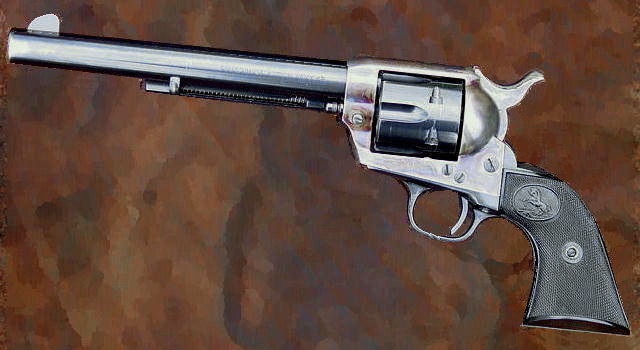
The Stardust encounters a city with alien beings who take no notice of the space-sphere. Then they come across an even more amazing sight – what seems to be a reenactment of a battle between American Indians and the United States Cavalry, Custer's Last Stand. Unable to resist, Rhodan lands – and one of the cavalry makes to attack them! “A sudden blast from Bell … made the apparition vanish” (p. 92) – but quickly afterward a crewman discovers an actual 1867 Colt Peace-Maker revolver lying in the tall grass. Rhodan ponders this and concludes that it is another test of their nerves. He stashes the revolver in the back of his belt.

He finally sets the space-sphere down again on a large landing pad near a great tower. They prepare to disembark. A measure of the elation that the Arkonides feel at the end of their quest is that Thora laughs merrily!

One final test confronts them on the ground, however. A rowdy cowboy blocks their way. He was plucked out of time from the instant of his death. He has the key to a gate through which they must pass to come into the presence of him. The cowboy is determined to keep it from them; by doing so for a half hour he will win his return to his own time and will live. His weapons can kill them – but theirs prove ineffectual against him. “I can't be plugged by you except in my time” he proclaims (p. 98). After various attempts to get through the gate by weapons and mutant powers fail, with only a short time remaining Rhodan draws the 19th-century revolver from behind his back and guns the cowboy down. His body vanishes, leaving the key. They pass through the gate and are greeted merrily by him.

Chap. 9, “Confrontation with – It!”

Through the raucous laughter, John Marshall shouts to Rhodan, “It is an interconnected entity, the living psyche of a supra-dimensional collective being, made up of billions of individual minds. You might think of it as an entire race having given up its material form in order to live on spiritually. We have here a voluntary denial of bodily existence after an inconceivably long span of life which the organism in its material form in all probability had become unable to endure any longer” (pp. 103-4)

It bids approach to its visible manifestation as a floating ball of energy. When Khrest, overcome by joy but hesitating, makes to do so, the old man is roughly thrust back against Thora. “It wasn't you I meant, Arkonide, I'm sorry to say.... I've already given your race a chance 20,000 years ago by your count. I cannot grant you, as the representative of a degenerated race, the secret of biological prolongation of life. The time you had has come to an end” (p. 105). Addressing Rhodan in Rhodan's own terms, as “old friend,” it beckons again. “'Step forward, sir!' Betty Toufry urged him. 'You were meant, not the pathetic old man.'” Rhodan feels himself taken up before the energy sphere as Pucky proclaims, “It likes to play as much as I do, but it plays differently” (p. 106).

Gathering his wits, Rhodan first demands that his injured crewman be healed. It is done. Then he accepts its offer of immortality. Of course, in reality, it is another test – the same chance as the Arkonides had received long ago, and others before them. It will only be the beginning of his journey.  It predicts that Rhodan too will one day tire of his physical body.  A humanoid form appears – an artificial man with a sixth-dimensional “intotronic” brain to act as the agent of it. He explains that the cell conservation treatment will last for 62 years, then must be renewed – and Rhodan will always have to find Wanderer again to obtain it or instantly decay will occur. Rhodan submits, enters the “Physiotron,” and emerges in the same state as he entered – but with his aging process halted for 62 years. Finally, he is given the opportunity to offer cell conservation to one other person. He chooses Bell.

Departing Wanderer, they hyper-transition back to Vega, finding that as promised the star has returned to normal.

“Alone, Rhodan reflected. The recognition the Immortal had granted him left him awestruck with its implications. With that single supramundane act a new era had been initiated. Phase I of the Space Age had ended and Phase II had begun. Soon all mankind would begin to think and operate not in national, global or even interplanetary terms but in stellar, interstellar terms.”

“All the universe beckoned” (p. 112).


* * *

And so ends the second “mini-cycle” of Perry Rhodan novels. The first (#1, Enterprise Stardust through the first skipped “special,” The Wasp Men Attack) had mankind encounter the first extraterrestrials, the Arkonides, and successfully hold off a series of alien invaders; the second (#5[a], Space Battle in the Vega Sector through this #13, The Immortal Unknown) finds humanity established as a minor interstellar power and Rhodan successfully complete his quest for immortality.


The unfortunate transposition of the covers between the German editions and the American editions for this and the last books was already discussed in the just previous post. Again, I know of no Gray Morrow painted cover. I own the Second Edition which sports the Johnny Bruck painting.  There are no interior line illustrations.


This American issue is dedicated to the memory of Edward E. Smith, PhD, "Doc Smith," a giant in the old pulp space opera field - writer of Lensman, Skylark, and quite a bit more.  
The Editorial: “The Mouse-Beaver Strikes Again!” Recounts the loss of the manuscript for this issue by the publisher, and the rush job re-editing from the carbon copy (!) to keep the printing schedule. It is interesting to pause and consider how, until very recently, the manuscript copy and perhaps a carbon, would be the only copies of a work in existence. Now multiple electronic backups are virtually a matter or course to prevent such a horrific loss of data. As it happened, even the carbon of the editorial which was to accompany it, which reported the results of the “New Name for Gucky” contest, was nowhere to be found. I imagine this is the same loss mentioned in the just previous post. “Forry Rhodan” also offers an explanation for the odd discrepancy noted in my post for #11, Planet of the Dying Sun, the table of contents for which announced an editorial entitled, “Rohan - ?! when the actual editorial was “Stardust Meloday.” That mix-up occurred, Forry said, because of a change in scheduling which required a new editorial too late to change the contents page to match. Perhaps. I imagine it's more likely that the change to the TOC was simply overlooked in the last-minute rush....

“Scientifilm World”: A catalog-list of various science-fiction/horror films that were in various stages of development in early 1972. Some, like Ben, I remember; others would never see the light of day. Some should never have seen the light of day!

“The Perryscope”: Another letter appears by Dwight Decker. I call attention to his name not to slight all the others who also have appeared, but because I recognize it due to his later effort to get Lemuria translated and published in English. He participates in something of a letter-column “debate” regarding the Ackermans' intention to pass over certain Perry Rhodan adventures that they judge to be of lesser interest to the majority of their readership – or even to “skip around” in publication to bring certain landmark issues to the US sooner, which he greets with horror. “Forry, these are not 540 [!] different, unrelated stories: what we are dealing with here is one 35,000 page supernovel that must be read chronologically. Sure, you can easily shorten or summarize the dull or slow adventures (the so-called “chewing gum” stories) but the idea of skipping around is as frightening as the idea of discontinuing the series entirely” (p. 119).

* * *

Pucky joins Rhodan's service as “Lt. Puck of the Mutant Corps” in this story. “Permit me, sir, not to say Pucky. It seems inappropriate to my honorable new position” (p. 37). He continues his “feud” with Reg Bell. He also goes on to save the day innumerable times (including once during the course of this tale) and generally contribute to the perception that Perry Rhodan is juvenile literature. I mean, come on, a talking mouse-beaver?

Several times Rhodan seems to perceive the presence of the Unknown, and addresses it directly as “old friend” (pp. 64, 71, 77). It's unclear to me whether he could really sense something that his fellows could not – in the past it's been indicated that his Arkonide hypno-training gave him some kind of extrasensory perception – or just trusting that the Unknown was watching and could see and hear him.

On p. 77, the Unknown greets then with “uproarious Homeric laughter” - according to Dictionary.com, this is “loud, hearty laughter, as of the gods.”

On p. 81, Rhodan admonishes his crew, “Don't jump to the conclusion that we've found God himself at work. We're merely face to face with a living being whose technology, science and culture must be millions of years old. He has learned all the laws of nature by scientific methods. What looks like miracles are no more than very intricate phenomena engineered with the help of machines.” Is this the first time that God has even been mentioned in Perry Rhodan? So far I don't think that religion itself has been dealt with at all. This is a very secular humanistic science-fiction series. A quick Google of “Religion in Perry Rhodan” comes up pretty much nil. Sometime I'll do a deeper search. Surely this has been written on somewhere (probably only in German, however).

Several times in this book an odd phrase occurs - “landing commando.” From the context, it seems to be what Star Trek and most other works call a “landing party.”

Custer's Last Stand is of course the Battle of the Little Bighorn, fought 25-26 June 1876.


I know virtually nothing of the history of firearms, but couldn't readily come up with anything on a “1867 Colt Peace-Maker revolver.” I was thinking “Colt 45”; perhaps it was this:


On p. 20 the Stardust's hyper-transition is described as being accompanied by a brilliant burst of light. Most recently that seems to be effectively conveyed in the reimagined Battlestar Galactica's “FTL jump”:


On p. 16 it is stated that the transition range limit of the Stardust is 35,000 light years.

I never knew that the command center of an Arkonide battle-sphere is located at its “geometric center” as stated on p. 17. I had always assumed that it was located at the “north pole.” But it stands to reason you would want your command center as protected as possible at the core.

What is the significance that Earth is at one focus of the far-flung elliptical orbit of the planet Wanderer? (p. 46)

A couple of minor characters are introduced in this story – Captain John McClears, left by Rhodan in charge of the “Guppies” in the Vega system, now happy as all get out to see the Chief return, and the Stardust's unflappable Chief Engineer, Manuel Garand.  I wonder if they show up again.

Next, it's back to the Solar System. There's no place like home. I'm curious to see how Thora and Khrest deal with the crushing of their dream, how Thora in particular reacts to the "superior" Arkonides' snubbing by It in favor of “the barbarians.”  ("You were meant, not the pathetic old man.”  Ouch.  That's harsh, Betty!)

Cheers, and Ad Astra!

Monday, June 6, 2011

Perry Rhodan #12, The Rebels of Tuglan (1972)


By Clark Darlton (= German issue #18, Friday 5 January 1962)

Chap. 1, “Of Rebels...”

On the planet Vagabond, a mousebeaver whose mutant intelligence outstrips that of its fellows and does not fade at night stows away on the Stardust II just before lift-off – and begins to “play” just as the ship begins its transition toward Vega.

Thousands of light-years away, the planet Tuglan, eleventh of the blue-giant star Laton, has been an outlying colony of the Arkonide Imperium for six millennia, though visited but seldom. Unbenownst to either race, the reddish-blue-skinned, violet-haired Tuglanians are descended from Arkonide explorers of six thousand years before that. The ruling Lord Alban of Tuglan plots to overthrow the resident Arkonide High Commissioner Rathon, who is typically degenerate and ill with leukemia. Alban is opposed by his brother Daros, who goes so far as to attempt to warn Rathon. His warnings appear to fall on deaf ears, but Rathon does covertly entrust a loyal Tuglanian with an investigative mission.

Chap. 2, “... and Robots”

One night, two Tuglanians are killed while sabotaging the sole Arkonide hyperwave broadcast installation on the outskirts of the capital city, Tugla, but not before they put it out of operation. Before the station goes down, however, the robots who tend it detect a brief hail from an Arkonide battleship that has just appeared in the system. Rathon reports these events to Alban, who sees his plans for Tuglanian independence crashing down around him.

Chap. 3, “The 'Impossible' Stowaway”

Aboard the Stardust II, Perry Rhodan immediately perceives that the transition to Vega has gone wrong. He eliminates the possibility that the telekinetic mutants had shifted the controls. Khrest recognizes the star near which they have appeared as Laton, 36,000 light-years from Vega. The galley reports a stowaway – when Rhodan and Reginald Bell arrive they find the mousebeaver calmly munching away on frozen fruit. When Bell angrily grabs it by the scruff of its neck, he is sent floating to the ceiling and dumped in an unused kettle of water, to the great amusement of his companions. Rhodan dispatches the dripping and discomfited Bell to change and retrieve the telepath John Marshall. Despite himself, Rhodan has already conceived an affection for the “beast” and even thinks of it as “he” rather than “it.” Marshall quickly establishes that this mousebeaver is quite intelligent, with “the makings of an excellent esper” (p. 49). Communication established, Rhodan forbids the mousebeaver, dubbed “Emby,” from further “play” aboard his ship. Nevertheless, within a short time, through a misunderstanding, Emby activates the hyperwave transmitter and gives away the Stardust's presence in the system. Rhodan decides to disguise the humans as Arkonides by means of makeup, white hair dye, and red contact lenses, and to approach Tuglan purporting to be an imperial inspection team.

Chap. 4, “Treachery on Tuglan”

Alban believes that the Arkonide ship is coming to investigate rumors of a revolution. He brazenly outlines his plan to Daros – that he intends to pin the sabotage and rebellion on his brother. Daros realizes that he has no proof against his brother's perfidy.

Entering orbit around Tuglan, Rhodan establishes contact with Alban – and goes along with the Tuglanian's misperception. To enable a telepath to accompany him in dealing with the Tuglanians, he has Marshall hypnotrained in Pankosmo, the galactic lingua franca. Emby is also hypnotrained to allow him to communicate with the humans: “'Teska vyt, jenmen.' And in English [the mousebeaver] translated: 'Good evening, gentlemen. I've also mastered the provincial language'” (p. 60). The Stardust lands at the spaceport outside Tugla.

Chap. 5, “Plots & Counterplots”

Rathon shows the “Arkonides” the destroyed hyperwave installation and reports the conflicting claims of Alban and Daros, as well as his own undercover operative – but when they establish a link to monitor Alban's agent in the palace, they remotely witness his death.

Daros leaves the palace unopposed but realizes that he is under surveillance. Then he finds himself being hailed by a mob of citizens - “Daros! Long live Lord Daros and the freedom of Tuglan! … Down with Lord Alban and his friends the Arkonides! Long live our liberator Daros!” (p. 68). Daros is both bewildered and horrified by this.

Rhodan meets with Alban, who professes disbelief at any notion that his brother could be the perpetrator of a plot against the Arkonides – and Daros plays right into his hands by barging in and accusing Alban publicly. Alban plays a recording of the citizens hailing Daros, and admits that he had been covering for him. Rhodan arrests Daros in the name of Arkon – then as they proceed back to the spaceport they are ambushed by a group of Tuglanians who purport to be freeing Daros. Rhodan and Bell do not resist and are taken prisoner; Rhodan perceives that Daros is as mystified by these developments as are himself and Bell, and he begins to suspect that this is all a show for the Arkonides' benefit. As he predicts, Bell is shortly taken from their place of captivity on a winding trip through the streets of the city – only to be “rescued” by agents of Alban. “[H]ow else will the Arkonides find out that Daros was liberated by his political friends?” Rhodan had predicted (p. 77). In meeting with Alban, Bell himself becomes sure that Alban is the real mastermind of the whole affair. He returns to the Stardust, determined to bring in Marshall to clarify things. He also realizes that Emby is no longer aboard the space sphere.

Chap. 6, “The Mind Reader's Revelation”

“Several things happened simultaneously.” Khrest and Rathon take Marshall to the palace and request audience with Alban. Bell and the “seer” Wuriu Sengu search the city for Rhodan to no avail. Rhodan is transferred to a cell elsewhere in the city from where he had been held. Unbenownst to him, Daros is moved nearby. “Only the fifth event had not been planned for” (p. 83). Emby has left the Stardust to “play” in the streets of Tugla – where he wreaks the predictable havoc. When he is accosted by one of Alban's police, he kills him, whereupon the rebels believe he must be on their side and join up with him, taking him to the rebel leader Karolan. The mousebeaver learns of his new friend Rhodan's plight.

Bell abandons the futile search for Rhodan, but is refused entrance to the palace supposedly on the orders of Khrest. Bell is immediately suspicious. In the meeting between Khrest, Rathon, and Alban, Marshall had quickly perceived the truth. But contrary to the Khrest's expectation the Tuglanian does not submit to the Arkonides' authority when confronted with the truth. He rather has Khrest, Rathon, and Marshall seized and imprisoned with Rhodan – beneath the palace.

Chap. 7, “The Floating Bomb”

Sengu locates Rhodan and the others, including one Bell presumes must be Daros in an adjacent cell. Bell and Sengu escape from the palace back to the Stardust. Bell selects several mutants, including Fellmer Lloyd, to accompany himself and Sengu in an armored tank while Major Derringhouse launches with a force of space-fighters. Unexpectedly, as they approach the palace, the Tuglanian people cheer them on: Lloyd feels their mood and reports, “[T]hey see us as allies. Their preponderant mood is one of hatred and fury,k but not toward us. They're filled with rebellious emotions. All are thinking of Lord Alban, spitefully and maliciously. They want to storm the palace and they believe we've come to help them.” Bell concludes, “The Tuglanians want to restore order. Our coming inspired them with the necessary courage. … They seem, therefore, to have always known that it was Alban and not Daros who wanted to rid them of the Arkonide empire” (p. 104). Sengu searches for the location of Alban.

Meanwile, Karolan, along with Emby, also approaches the palace. The Tuglanian has the mousebeaver telekinetically float a bomb across the gate where it blows a yawning gap though which the rebels pour. Emby sets out in search of Rhodan.

Chap. 8, “The Death of...”

In desperation, Alban announces over loudspeaker that unless the Arkonide attackers back off he will kill Rhodan and Khrest, and heads for the cells to make good his threat. Sengu guides Bell as he races toward that location. Alban arrives first. Rhodan stalls for time as Marshall detects Emby also approaching – then is rewarded when the mousebeaver unleashes his telekinetic force on the Tuglanian. He raises Alban's gun, carrying the Lord of Tuglan with it to the ceiling from which he falls. Although it is not a great height, the way he hits is instantly fatal. When Bell shows up, he is discomfited that that “damned Mickey Mouse” beat him to the rescue (p. 113). They free Daros and install him as the new Lord of Tuglan.

The Stardust leaves Tuglan and heads out toward its interrupted hyperspatial transition to Vega. Rhodan and his companions ponder whether these events might have indeed been another part of the Galactic Riddle. As reward for his part in the resolution of the abortive Tuglanian rebellion – and saving Rhodan – Emby is made a member of Rhodan's crew. He also gains a new name, “Pucky,” bestowed upon him by “a young crewman from Independence, Missouri …. 'Shades of Shakespeare,' Phillip Callen began, 'If Emby doesn't have the personality of Puck! … Puck – from Midsummer Night's Dream. … Pucky!'” “[A] name destined to become famous throughout far expanses of the space-time continuum” (pp. 117-118).


* * *

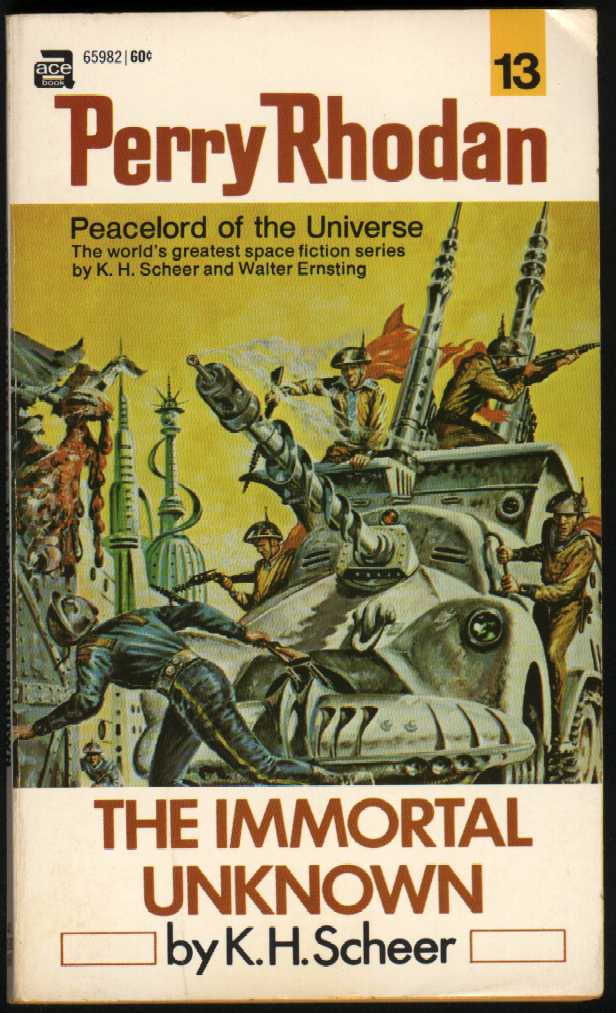
Once again I know of no Gray Morrow cover for the American edition. I am in possession of the second printing which is the same cover as above, from the German issue … #19. Oops. It seems that in the American publication the Johnny Bruck covers for this story and the next were transposed. Which is a pity, considering that these two covers seem each to have been a bit more appropriate to their subject matter than usual. Had the correct covers been used, we could have also had an illustration of an Arkonide tank, complete with the “spiral-shaped barrel of its pulse-ray cannon” (p. 103). And next issue could have had the more iconic image of Perry Rhodan, I presume finally in the presence of The Immortal Unknown. I do notice we have a somewhat accurate-looking image of an Arkonide space sphere, complete with the equatorial bulge or ring, on the present cover.

Remaining on art for a second – sans Gray Morrow cover, this issue nonetheless had Gray Morrow interior art. Here are the illustrations:

page 15
page 36
page 45
page 81
page 116
Unfortunately, it's not Morrow's best work, in my humble opinion not of the same quality as his cover paintings. And most of the images are not readily identifiable as particular characters or objects. Even the one woman, appearing twice, who must be Thora, doesn't look like what I take to be Thora on his various painted covers. 

Original painting for Ace Perry Rhodan #70

 What other woman is there besides a couple of the mutants?

The dedication of the American edition was to the memory of “E. Everett Evans, Galactic Roamer” (p. [4]). Here's the Wikipedia entry, short enough just to quote in full: “Edward Everett Evans (1893-1958) was an American science fiction author and fan. His works included the novels Man of Many Minds (1953), The Planet Mappers (1955), Alien Minds (1955), and the posthumously-published collaboration with E. E. "Doc" Smith Masters of Space (1976); and the collection Food for Demons (1971). A free eBook version of Man of Many Minds is available.”

The editorial “From the Captain of the Stardust 4E: Sci-Fi Knowledge Comes to College” notes the change from forty years previous when science fiction was “academically put down” to ca. 1970 when “courses are eagerly taken up in high schools, sought and taught in colleges across the country” (p. 7).

Note: According to Mark Golden's synopsis of this German issue linked above, this was not the original editorial for the American edition. There was a “lost” editorial which announced the winner of the #9, Quest Through Time and Space's “Rename Gucky” contest. Consequently the winner was never formally announced, although Golden reports that Forrest J Ackerman was said to have later mentioned the name of the winner as one Phillip Callen, presumably of Independence, Missouri, who thus found himself immortalized as a “Spaceman First Class” member of Rhodan's crew in this issue.

Golden also notes that the final scene in which “Emby” is renamed “Pucky” is itself written by Ackerman. In the German original, according to the German synopsis at the Perrypedia website, pretty much immediately after discovering the mousebeaver aboard his ship “Rhodan gibt ihm aufgrund seiner treuherzig blickenden Augen den Namen 'Gucky',” which a little massaging of the Google Chrome web-page translator seems to render as “Rhodan gives him the name 'Gucky' because of his ingenuous-looking eyes.” According to http://dictionary.reverso.net/german-english/Guck, Gucker can mean “eyes.” Perhaps someone more knowledgeable in German than myself can explain...? (After using the name “Emby” throughout the book, in the final scene Ackerman felt it necessary to explain that word's derivation. Do I really need to? Hint – it's typically Forry.)  I have wondered from time to time why the Ackermans didn't just rename Gucky as "Mickey," after Mickey Mouse.  Bell refers to him as such at one point (possibly added in translation? I don't know).  Maybe it was that a one-time use of The Mouse's name might fly as a cultural allusion, legally speaking, but formally renaming a continuing character with that name would not.  Even ca. 1970, nobody messed with The Mouse.

“Scientifilm World” celebrates “one of those rarities, the outstanding picture of a believable tomorrow or the decade after or the century after” - Stanley Kubrick's A Clockwork Orange (1971). “Unfortunately for a number of you readers, you'll have to wait till sometime between 1975 & 1980, depending on your present age, because this is an 'X' film and not for nadsats under 18. (Nadsat is one of the many strange made-up words in the picture and means teenage ...)” (p. 121).

And of course there was “The Perryscope” letters column.

* * *

And so the German Perry Rhodan series entered its second calendar year of publication. I don't have a whole lot of story commentary this time.

Only Rhodan and Khrest are in the Stardust's Command Center during the transition at the beginning of the story. This is contrary to my own conception of a typically “busy” starship bridge, formed of course by Star Trek, which I must now envision more like sparse, even low-budget sci-fi sets – even (horror) Mission Stardust.

I was struck by Rhodan's slowness in reading the situation on Tuglan. He seems to have a preconceived notion that the people under Arkonide rule must long for freedom and that the rulers are Arkonide puppets. In this case, not so. The ruler is himself the rebel while the “rebels” turn out to be loyal to Arkon. I'm not sure if this is followed up in other instances in the series. But one reason I found this story a bit difficult to summarize was that, as the fifth chapter is entitled, “plots and counterplots” abound. Lord Alban plots against the Arkonides but ultimately framing the rebels; the rebels are in reality plotting against Alban; Daros is kind of caught in the middle.

If telepath John Marshall was hypnotrained to allow him to accompany Rhodan in dealings with the Tuglanians, why is he not there in their meetings from the beginning? Rhodan would then have seen through the plots from the beginning … and we would have had a much shorter story! That's the problem with too powerful characters – the author has to contrive ways to keep them from solving problems too quickly, or just ignore them until it's narratively convenient to bring them in.

Here's the description of the Arkonide robots manning the hyperwave station on Tuglan: “The three robots represented a top product of Arkonide electronics. They were equipped with mechanically working memory storage banks and were powered by a never-failing atomic battery. Their external appearance was that of a typical Arkonide, except for their metallic skin which gave away that they were nothing but machines” (p. 25). Typically, however, robots are depicted as more “robotic” on various cover illustrations, both German and American:


I'm not sure what “mechanically working memory storage banks” are, but apparently not the same as the positronic brain such as at the core of the Stardust as well as, at least I presumed, the robot “Markon” in #9, Quest Through Time and Space.

On p. 57, Pankosmo is identified as “the Esperanto of [the Arkonide] empire.” Forrest J Ackerman was a great proponent of the artificial language Esperanto; at least at one time, there existed “Ackerman's personal page about Esperanto” (per the Wikipedia article on FJA, note 7, which gives a link that on the date of this blog entry is currently dead). On a whim, considering that there is something of a tradition of using Esperanto when one wants to represent a foreign language without going to the trouble of developing a consistent foreign language (Wikipedia, “Esperanto in Popular Culture”), I tried translating the short sample we are given here. It's not Esperanto, however. I do like how Emby/Pucky refers to English as “the provincial language”!

Tuglanian “cars” are interesting, described as having “two wheels and a gravity gyroscope” (p. 64). Sounds kind of like a scaled-up Segway/GM PUMA:


That looks like fun!  Cheers and Ad Astra!

(Okay, I thought I didn't have a lot of commentary this time....)


* * *


Sentimental note:  This was one of my original copies of a Perry Rhodan book, purchased way back in the 1970s.  (Remember, I have been filling in the gaps of my collection via online booksellers.)  I found a reminder of days-gone-by in it.  When I was a teenager, I worked part-time for my father's business, Hare Engraving Company, making "rubber plates" that were used in printing newspapers and book covers.  My job, besides making pickups and deliveries to our major client, was taking the zinc plates etched by my father (based on a photographic art design via sulfuric acid etching), making a bakelite mold from that zinc plate, then making a rubber plate that was a duplicate of the zinc plate.  The rubber came in big rolls, about a tenth of an inch thick, and was backed by a red or green sheet of thin plastic - which was basically discarded.  Except that it made a perfect bookmark.  I had many of those bookmarks, cut typically to about 1" by 6", and I still occasionally find them in old books.  They always take me back to those days....