Dedicated to the memory of K. H. Scheer and Walter Ernsting, who first gave us Perry Rhodan in 1961 and of Forrest J and Wendayne Ackerman, who first brought his adventures to the United States in 1969.

Thursday, May 19, 2011

Perry Rhodan #10, The Ghosts of Gol (1971)


By Kurt Mahr (= German issue #16, Friday 22 December 1961)

Chap. 1, “Spooky Phenomena”

Eight auxiliary space spheres, nicknamed “Guppies,” launch from the Stardust II to distribute themselves throughout the Vega System with space-time structural sensors scanning for disturbances. Meanwhile, Perry Rhodan has to deal yet again with the Arkonides' timidity. He gives Khrest and Thora a choice – accompany him continuing the quest for the secret of eternal life or not, but they must decide! Guppy #5, near the fifteenth planet, starts experiencing spatial oscillations that set the very hull to droning and blows out the structural sensor. They did manage to get a lock on the source, however – the fourteenth planet of Vega.

As Thora and Khrest prepare to give Rhodan their decision, the three are interrupted by the metal cartridge retrieved from the distant past of Ferrol gives off a blazing light and basically evaporates before their eyes. In quick succession, Rhodan gets the report from Commander Chaney of Guppy #5 as well as the electromagnetically sensitive mutant Tanaka Seiko's report of the message he perceived at the same time: “You shall come now. … Remember the warning! Continue your search where the disturbance occurs. … Do not come without the higher knowledge! Nobody will help you, only the mountain will pulsate for you” (pp. 20-21). Rhodan orders an almost immediate launch for planet fourteen – then remembers Khrest and Thora. Khrest laughs and says they had decided to accompany him.

Chap. 2, “Perils of Gol”

Vega 14 is a monstrous gas giant three times the diameter of Jupiter but with an enormous density, and therefore an even more monstrously enormous gravity and atmospheric pressure at its surface – 916 g's and 50,000 atmospheres under its own 12,000-mile thick atmosphere. Only the Stardust has the power to withstand the strain by means of its engines and gravity generators working in tandem to negate the terrific gravitational force, so the auxiliary ships are sent back to Ferrol. Rhodan orders surface exploration vehicles to be outfitted to withstand the grueling conditions.

Bell christens the planet “Gol,” “after an abominable ogre in some old legend” (p. 26). As the Stardust II descends into the planet's atmosphere, the first of what becomes a series of regularly recurring sixteen-second structural disturbances is detected. Seiko detects no message, however. Rhodan heads for the coordinates from which the disturbances originate, which turns out to be a twelve-mile high mountain unsuitable for landing. A more suitable landing area is about 120 miles away. Rhodan manages to set the ship down in what turns out to be a sea of thirty- to sixty-foot deep liquid methane, the same compound as the atmosphere. Actually, “[t]he gravity neutralizers together with the engines kept the Stardust in a weightless state even after the landing. The support legs had found solid ground but did not depend on it” (p. 33).

After testing a remote-controlled caterpillar-track exploration vehicle, Rhodan, Major Derringhouse, and Seiko set forth for their first survey of the utterly alien landscape, heading for the foothills beyond which is the mountain range that contains their goal. An infrared search beam provides their only “light” so deep in the thick atmosphere. But then, mysteriously, as they come to a sheer rock wall, that searchlight dies.

Chap. 3, “Glowing – Beings?”

Khrest has gotten nowhere in analyzing the continuing intermittent structural disturbances for any message that might be encoded in their modulation. Suddenly the Stardust lists to one side. Momentarily two of the gravity generators had run idle then resumed normal operation. Reginald Bell easily rights the ship, but is upset by his inability to find an explanation. A glowing shape appears in the murk outside. Khrest speculates that it is a random electrical discharge. Receiving a report of the caterpillar's dead searchlight, Bell orders a radio beacon deployed to guide Rhodan back. Making its way gingerly through the treacherous landscape, the caterpillar encounters a similarly glowing shape, whereupon Seiko is stricken by an intense roaring “sound” that only his mutant abilities can “hear,” and an intense headache. Rhodan is unable to catch up to the flitting light and finally, slowly, makes his way back to the Stardust.

Rhodan meets with his people and reveals that he roaring that Seiko perceived in conjunction with the appearance of the light was indeed hyper-radiation. He also believes that the searchlight was intentionally put out of commission. Perhaps the lights are living beings. With Khrest's help, Rhodan sets out to devise a way to convert the structural sensor in the a modulation receiver – he is still convinced the structural disturbances contain a message. His efforts pay off. Through the medium of the new device, Seiko is able to “read”: “Even though you have perceived this, you must follow the way to the mountain. Only there is the light hidden. Do not wait long. The mighty ones of [Gol] will overpower you if you hesitate too long. Do not come without the higher knowledge!” (pp. 54-55).

Chap. 4, “The Valley of the Phantoms”

Three caterpillars set out from the Stardust. Rhodan drives one, accompanied by his previous crew plus telekineticist Anne Sloane; Bell is accompanied by the young telepath/telekineticist Betty Toufry, teleoptician Ralf Marten, and Major Nyssen; and Khrest is telekineticist Tama Yokida, teleporter Ishi Matsu, and Captain Klein. Rhodan attempts to use catapulted “oxygen-bombs” (oxygen and methan are an explosive combination) to blast his way through the rock wall encountered previously, but the first such blast attracts a small light sphere which seems to absorb the second – and swells from twenty inches diameter to fifteen feet. He then resorts to disintegrator cannon to blast a hole big enough to drive through. The three caterpillars emerge into a broad smooth plain and continue on toward the mountain. The glowing ball follows them but slowly diminishes in size. At Bell's urging, they try disintegrator fire against it, only to find that it “feeds off” that as well. Seiko continues to be plagued by a headache.

Receiving a report from Thora aboard the Stardust that more glowing balls have surrounded the ship and that the intermittent failures of gravity generators are increasing, Rhodan feels pressured to reach their goal as quickly as possible. The expedition passes through a natural fissure in another rock wall, but emerge atop a sheer precipice overlooking a deep valley filled with many of the glowing forms. Derringhouse dubs it the “Valley of the Phantoms.” They manage to follow a descending ledge along the cliff face down to the valley floor. But then a report back to the Stardust goes unanswered.

Chap. 5, “Encounter with the Ghosts”

Thora had been listening to the progress of the caterpillars until the point where they entered the valley – whereupon clanging alarms shattered the calm aboard the Stardust. All gravity neutralizing screens are down and only the ship's engines are supporting them. Thora finds herself at a loss as to how to proceed, finding herself longing for Perry Rhodan's presence of mind and cursing his absence at the same time. But she rallies herself and uses Wurio Sengu's power of “seeing” through matter to determine that the glowing spheres outside the Stardust react to energy fire just like the one dogging Rhodan's expedition. As engine power begins to decline, Gol's massive gravity seeps through, subjecting the crew of the Stardust to mounting g-forces. Thora attempts to launch the ship, but the engines fail altogether. They are only saved by the resumption of the structural modulation, which seems to drive the sphere's away.

Thora reestablishes contact with Rhodan, who orders her to launch and maintain a safe altitude beyond the range of the spheres, about a thousand miles up, and to fly the Stardust to a position above the valley. Rhodan and the caterpillars proceed forward – the light of the massed spheres is sufficient for them to turn off their search beams, which removes the caterpillars' attraction at least for the time being. But as they penetrate deeper and deeper into the valley, the spheres get denser and denser and harder to avoid. Knowing they are about to be detected, Rhodan tries a diversion. All three caterpillars fire at a single point well away from their own position, and the spheres take the bait, flocking away from the caterpillars toward a much richer feast of energy. The caterpillars continue forward and ultimately leave the field of phantom lights, coming safely to the base of the mountain.

Chap. 6, “A Message from the Unknown”

The caterpillars start ascending the lower slopes. Rhodan has concluded that the lights, higher-dimensional beings though they be, are unintelligent and driven solely by instinct. Moreover, he believes he has a way to repel them. He orders Thora to descend from its hovering position and use his remodeled structural sensor as a transmitter, as well as to flood the area with infrared light so they can see. The light spheres scatter from the Stardust's broadcast as when the sixteen-second modulation had resumed. The massive space-sphere is able to land unmolested in the valley.

But Seiko now “hears” what seems to be the buzzing of a swarm of angry hornets. As a precaution, Rhodan sends Bell's and Khrest's caterpillars back to the Stardust. They are to help Thora in case of another attack, but also to build a second structural disturbance transmitter. Major Nyssen is then to bring that transmitter to Rhodan, who continues on. Bell and Khrest complete their task quickly, and Nyssen heads back out on the trail of Rhodan.

Rhodan has meanwhile reached the true base of the mountain, which turns out to be a needle-like formation soaring into the sky. Seiko perceives another message: “You are on the right way. Keep going! Are you endowed with the higher knowledge?” (p. 94) The outline of a great door can be seen on the side of the mountain. Rhodan orders Sloane, “I assume that it takes a telekinetic knack to open it. Please apply your higher knowledge” (p. 94). But at that moment a large group of the energy balls appears, bearing down on the door.

Miles away, Nyssen's caterpillar is overtaken by a storm front. Buffeting winds are accompanied by a radical drop in temperature. Formations of frozen methane solidify out of the atmosphere almost immediately and trap the caterpillar. Nyssen calls for help from the Stardust, but before that can happen both the caterpillar and the space-sphere come under renewed attack, by a new, more effective tactic. The generators are attacked directly and start to fail. The crews are subjected to rapidly mounting gravity.

At the mountain, Sloane manages to open the door and Rhodan guns the caterpillar through just ahead of the lights. They enter a large circular chamber occupied by a single apparatus – an “impulsator” like that found in the factory-like hall of #8, The Galactic Riddle, a remote hyperspace matter-transmitter. Once again, it is up to Sloane's telekinesis to activate the mechanism.

Chap. 7, “Beyond the Galaxy”

Rhodan and his companions have the impression of “ – [a]n endless time” – “no prior transition [in Rhodan's experience] had taken as long as this one” (p. 109). They reappear in the Command Center of the Stardust. Nyssen and Klein and their caterpillar have also appeared in the ship's hangar. But the ship itself has been thrown to an entirely unknown sector of space, outside the galaxy, where only a handful of stars can even be seen. Seiko alone sees a glowing ball suspended in the middle of the Command Center – “and became terribly frightened, believing at first that it was a light body” (p. 111). It is not. And he alone “hears” a message from their “unknown mentor”:

“You have been warned! Now find the world where the coordinates are secured. Remember that you cannot return home if you do not know the right way. Your goal is far!”


* * *

First, the requisite silly cover question: Is that Saturn Girl of the Legion of Super-Heroes?


That impression is only reinforced by the hypnotic concentric (thought?) waves radiating from the female eyes in the background of Gray Morrow's painting. And if so, is that Lightning Lad with her? … Doesn't really look like him. Just for the heck of it, I and a lot of other people had a similar “Is that Saturn Girl?” moment not too long ago when T-Mobile's new (and cute as all get-out) spokeswoman Carly Foulkes appeared in similar attire:


Again, this Ace publication initially appeared with the Johnny Bruck German cover art and the Gray Morrow art only appeared by the third edition (1974) which is what I have. I'm not sure what the second edition looked like. Bruck's painting again at least somewhat reflects some scene in the story.

This volume begins with the Editorial “From the Captain of the Stardust 4E: The Glowing Coal,” celebrating the appearance of Perry Rhodan #500: Aliens from the Void, by K. H. Scheer, earlier in 1971. At one adventure per month, Ackerman forecast that the English translation would be published sometime in the 21st century. But he held out hope for an increased frequency of publication as well as the possibility of judicious use of summaries of some issues as well as special editions of the anniversary issues years before they would normally be published. Except for a couple more adventures to be skipped altogether in the near future (like The Wasp Men Attack), which Ackerman himself apparently later repented, only the increased frequency would come about – for a time.

The aftermatter consisted of “Scientifilm World,” this time a review of First Spaceship on Venus (1962), and “The Perryscope” letters column.

Some notes and commentary:

On p. 15, Rhodan refers to the “Fable of the Fox and the Sour Grapes” when Khrest and Thora would quit the quest altogether since it seems the universe in not going to arrange itself for their convenience as Arkonides have become accustomed to. This is originally a story from the Greek fabulist Aesop; Wikipedia quotes a brief translation of the Latin version by the Roman Phaedrus:

Driven by hunger, a fox tried to reach some grapes hanging high on the vine but was unable to, although he leaped with all his strength. As he went away, the fox remarked, 'Oh, you aren't even ripe yet! I don't need any sour grapes.' People who speak disparagingly of things that they cannot attain would do well to apply this story to themselves.

I can find no reference to any legend of “an abominable ogre” named Gol to which Bell refers in naming the monstrous gas giant on p. 24. Perhaps it's a German legend?

There is an interesting exchange between Thora and Rhodan on p. 49. After Rhodan has revealed to his fellow Terrans his theory that the glowing balls of light are “higher order” beings, she cautions him:

“You ought to be more careful.... You're talking to your men about beings living in a higher order of space. I'm not sure whether these people, although they are majors, are familiar enough with the concepts of hyper-geometry to know that there's no value judgment expressed by that.”

Rhodan takes her seriously: “That's a good point. I'll keep it in mind. … Still, it does state a value.... We can achieve a transition, we can modulate hyperwaves and broadcast them. But we're at a loss as to how to handle a being whose abode is in higher space. Anybody living in space of n dimensions eludes by this fact alone the grasp of those in (n-one [read “n minus one”]) dimensional space.”

Kurt Mahr really seems to have been the original cadre of authors' go-to-guy for describing treks across alien landscapes. I found a lot of echoes in the general mood of this story to #4(b), Base on Venus, which he also wrote. Just one parallel: In both stories, our heroes have a mountain as their goal, and encounter various dangers along the way.

Mahr also took time to describe the varying reactions of Rhodan's people to their situation – p. 64:

“The crew aboard the carriers had mixed feelings. Tanaka Seiko was still suffering from a splitting headache because the huge sphere kept following the vehicle doggedly. Rhodan had retreated into the cold and determined toughness which was at the core of his personality in such critical situations. Reginald Bell and Major Derringhouse vied with him in his toughness but embellished it with a certain show of flippancy and a devil-may-care attitude. Khrest had not uttered a word in the last few hours. He seemed convinced that they were on a straight path to hell and so apparently was Anne Sloane, who was squatting apathetically on the floor of Rhodan's car with a vacant look and showing little interest.

“Major Nyssen was a strange man. Rhodan had never known this aspect of his qualities. Nyssen, who outwardly so much resembled Reginald Bell, had developed during the last few hours a certain fanatical urge – without losing his sense of reality or overestimating the limiting circumstances of the expedition – to subdue the energy bodies which seemed to constitute the greatest danger to the Stardust ….”

Mention of Anne Sloane's depression a moment ago brings to mind what might be the quotation of the issue! – “'Don't be afraid, baby!' [Rhodan] smiled when he saw how pale [Anne Sloane's] face was” (p. 78). I laughed out loud at that.

Once Rhodan's expedition penetrates the mountain, I hesitated a moment – Rhodan might have recognized the “impulsator” (p. 105), but I had no idea to what that word referred until reading further. Did I miss it previously being given that name? I comment on it because this seems to have happened before – some new fact or term being dropped in without (what I consider to be) proper introduction. Luckily, it quickly became clear in this case. But I think this must be another result of the series' “writing by committee” and the sheer rapid pace that these stories appeared. As Mahr was writing this story, had he had a chance to read Darlton's #8, The Galactic Riddle?  Perhaps something similar explains the out-of-the-blue dubbing of the auxiliary spheres as "Guppies."

My gut feeling is that the description of Gol is too fantastic to be realistic.  I mean, it's described as a "gas giant" three times the size of Jupiter, with an "enormous density" and gravity over nine hundred times that of Earth.  Jupiter itself has a density about one-quarter that of Earth, with a gravity about 2-1/2 times.  I frankly toyed with the idea of trying to see if the math worked out, but just as frankly I found it beyond me - or at least the time and effort that I'm willing to put into it.  Anyone else wants to have a go at it, be my guest.

* * *

As an addendum to my just previous post, about the Perry Rhodan movie that might or might not really exist (see the first paragraph here), I have a confession to make. Since viewing that film, bad as it was, I find it has changed my mental image of one of the major characters. Contrary to what I stated a few posts back (here), no longer is my mental image of Thora formed by Gray Morrow's cover to Ace #70 … now I see Essy Persson.


That is not at all unpleasant....

She's the only one, however. I still “see” Rhodan as in the banner above, from Morrow's cover to Ace #50. Frankly, I found most of the other main actors pretty interchangeable among themselves and even with the movie's Rhodan. Except for Khrest – but even so, I still retain as my mental image of the elderly Arkonide scientist US Representative Tom Lantos.


Imagine him with red eyes.  Even years after I was reading the Perry Rhodan series in the 1970s, when Lantos emerged on the political landscape (the 1980s? 1990s?) I immediately thought of Khrest, specifically of this image:


Cheers, and Ad Astra!

Saturday, May 14, 2011

Special: The Perry Rhodan Movie ... Mission Stardust (1967)

With classes over for the semester, grades turned in, and my courses for the summer all set up, I took a day off yesterday for myself. On a whim, because it had been on my mind since referring to it several posts back, I found the Perry Rhodan movie on YouTube.

Yes, it's as bad as they say. I'm not going to post a full synopsis. For one thing, I didn't take notes and a perfectly good overview is available through the Turner Classic Movies website. Here are just a few comments.

Actually, despite the obviously low budget special effects from the very beginning, and an early scene introducing a James Bond-esque master villain – complete with his purse-dog in one scene – the first half hour or so seems to follow #1(a) Enterprise Stardust fairly closely. Then suddenly Thora and Rhodan go into her bedroom so she can change into her “flight suit.” She reveals her and Khrest's mission, to revivify the declining Arkonide race by merging with a younger, more energetic people. Humans are not, of course, advanced enough for Thora's purposes … she believes. They are only Level 4 to the Arkonides' Level 9. Before long, however, Rhodan has pulled her forcefully to himself and planted a big wet kiss on her lips just before he stalks out, with the parting shot that she will find he can easily slip to a Level 3. Whereupon Thora falls back dreamily onto her bed....

And the wheels really spin off from that point forward as the story departs further and further away from what I guess originated as not just the first German issue, but the second and third as well. In the end, however, Thora and Perry Rhodan are locked in a deep embrace and obviously about to set about merging their races ….

All in all, though, I can't say this movie is much worse than many other B-movie sci-fi flicks of the era (or later), or even as an adaptation of the source material than was, say, the 1975 Doc Savage movie of that great pulp hero. I imagine that, like the latter (in which case I myself am an example) the Perry Rhodan movie, no matter how bad it was, did have the effect of introducing someone to the saga itself.

Now, for your enjoyment, here are some pictures that I found here, there, and yonder on the internet:

The Italian title
The German title

Various promos and packaging - yes, it's available in English on DVD (see the TCM link below).

Perry Rhodan

I think this is Rhodan, Thora, Flipper, Manoli, and Bull.  I could be wrong.

The actor who played Khrest, from another movie because I could find no image of him from this movie.

A couple more pics of Thora - changing into her flight suit before Rhodan, and immediately post Rhodan-kiss.

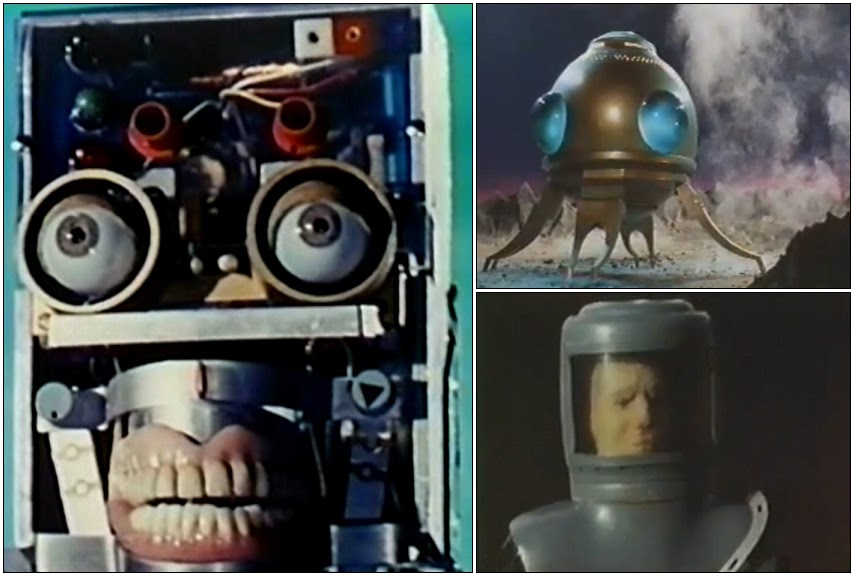
An Arkonide robot's innards, the Arkonide space sphere (the auxiliary craft looked the same only smaller), and the robot's normal appearance.
Cheers, and Ad Astra!

Tuesday, May 10, 2011

Perry Rhodan #9, Quest Through Space and Time (1971)


By Clark Darlton (= German issue #15, 15 December 1961)

Chap. 1, “The Crypt of Light”

Perry Rhodan and his crew have been waiting for three Earth weeks for the positronic brain aboard the Stardust to decode and translate the message retrieved at the end of the last adventure. A partial solution is presented: ONCE THE PLANET ON WHICH YOU ARE NOW STAYING HAS ROTATED 21.3562 TIMES AROUND ITS POLAR AXIS, THE INSCRIPTION WILL FADE AWAY. THEREFORE HURRY IF YOU WISH TO FIND THE LIGHT (p. 17). Given the slightly longer day of Ferrol, Rhodan calculates that three days and fifteen hours (Earth time) remain – before the message and all record of it vanish. Masters of time and space as the immortals seem to be, Rhodan surmises that once the time limit is up, it will be as if the message had never existed.

Three more Earth days pass. Then, with only a few hours to spare, the brain spits out the finished translation: IF YOU KNOW SOMETHING ABOUT OUR LIGHT, YOU MUST SEEK OUT THE ONE FROM WHOM YOU OBTAINED THIS KNOWLEDGE. ONLY ONE PERSON WAS AMAZED BY THE MACHINES OF KNOWLEDGE – THIS WAS IN RECENT TIMES, JUST A FEW SECONDS AGO ACCORDING TO MY CHRONOLOGY. SEEK HIM OUT AND ASK HIM! IF YOU WANT TO FIND HIM, THEN YOU MUST COME TO THE CRYPT OF THE LIGHT, BUT DO NOT COME WITHOUT SOME INFORMATION ABOUT HIS PERSON. YOU WILL BE ASKED WHAT HIS NAME IS (pp. 23-24). Rhodan and company set out to discover the initial source of the information that brought them in search of the secret of eternal life – the Arkonide explorers ten thousand years ago whose records had led Khrest and Thora on their quest. Rhodan believes that the ancient records can be most quickly accessed at the larger positronic brain on Venus.

Chap. 2, “The Story of Kerlon”

The Stardust departs Ferrol, hyperjumps to the Solar System, and approaches Venus, dropping off Rhodan and Khrest in one of the auxiliary space spheres before proceeding under the command of Reginald Bell to Galacto-City on Earth. Col. Freyt reports to Bell that negotiations are slowly bringing Rhodan's dream of one united Earth government closer to reality. On Venus, Khrest and Rhodan view the ancient 3-D film records and learn the name of the ancient commander: Kerlon. They head to Earth to rejoin the Stardust. Meanwhile, the gigantic space sphere's cargo of Ferron trade goods have been unloaded and Terrestrial trade goods have been loaded. Three days later, the Stardust jumps back to Vega.

Chap. 3, “Battle in the Past”

In a meeting, Rhodan reveals not only his and Khrest's findings on Venus but also his own conviction that rather than a race of immortals they are dealing with only one. “Way back when the immortals landed on Ferrol they were still existing as a race. Then, for unknown reasons, they decided to emigrate from the system. At the same time some catastrophe befell them which brought about the extinction of their race, despite their immortality. Only one of them survived. He did not want to keep the secret to himself and decided to find a worthy successor. He devised the galactic riddle. Whoever could solve it would be rewarded with the secret of eternal life. He set the trail, probably later than we originally assumed. ...” (pp. 43-44).

Rhodan and a team consisting of himself, Khrest, Bell, John Marshall, Anne Sloan, Dr. Haggard, Ras Tschubai, Ralf Marten (who has been “complaining that he has to stay too much in the background” [Bell, p. 45]), and the Arkonide worker robot previously enabled with five-dimensional thought enter the Time Vault beneath the Red Palace on Ferrol. But when the time-lock field is deactivated, the matter transmitter previously there has been replaced by a chair upon a small platform. Rhodan takes a seat and, with a hum and vibration, an energy screen obscures his view of the others. He feels an alien force scanning his mind, then everything returns to normal. As the others cluster closely around him, the platform descends, carrying them downward into the floor.

They end up in a large empty chamber at the center of which a metal cube fades into view. The cube bears the writing of the immortals, which the robot (Rhodan refers to it as “Markon”) translates as “Now seek out the man whose name you know. Only he possesses what you need in order to find the way to the Light. Do you know the meaning of time?” (p. 51). The robot further identifies the cube as a “time-transformer,” in effect a time machine set to a specific destination in time. A telepathic message impinges on their consciousnesses: “I am speaking to the one who has followed my trail this far. When you arrive, be on guard; don't let yourself get killed. No one will come to your assistance; you must help yourself. And only if you find Kerlon, and with him that which will show you the way to the Light, will you be able to return to your own time. Wait for a period of three days, not more nor less. Only then will the machine bring you back again. I hope you will succeed in this task. I have been waiting for such a long time already!” (p. 53) As the message ends, the walls of the chamber transform into a rough-walled dungeon with a stout wooden door. The sounds of battle – screams, shouts, clanging of swords, an explosion – come from outside.

Cautiously opening the door, they find several dead Ferrons in armor. Rhodan dispatches Tschubai to scout the area. Teleporting outside (and having to teleport again quickly when his initial destination, the throne room of the Red Palace turns out to be open air far above the ground!), the mutant encounters a group of four Ferrons with whom he can communicate since he knows the “New Ferron” language of ten thousand years hence. They are ancestors of the Sichas (see #5b, Mutants in Action), and enlighten him as to the current conflict. They are scavenging the field for weapons and armor after the most recent of several battles in which a neighboring castle-holder is trying to seize the castle where the Red Palace will one day be built. The Sichas believe Tshubai to be friends of the “Gods of the Sun” (p. 59) – the immortals. Suddenly, Tschubai and the Sichas come under attach by a dozen soldiers. Tschubai's Arkonide ray gun, set to its lowest level of stun only, quickly knocks the attackers out. The Sichas bid him farewell as they leave for their mountain home – then are astonished to see him vanish into thin air, teleporting back to Rhodan's group.

Chap. 4, “The Gods Intervene”

Inside the castle, Lesur, the district Thort (one of many on Ferrol at this time), leads his people as they retreat further into the vaults below the castle, driven back by the latest assault. One of his soldiers comes to him with a tale of seeing “the Gods” outside the now-open door of the “holy chamber.” Lesur dashes for that chamber.

Back with Rhodan, Tschubai renders his report. The group are discussing what to do when they hear the sounds of the Thort and his men approaching. Upon seeing “the Gods,” the Ferrons prostrate themselves. Marshall reads the Thort's mind and mentally reports to Rhodan that “[h]e believes us to be Gods who've come in order to help him against the barbarians. … His name is Lesur, the Thort” (p. 68). Rhodan plays along. Upon learning the situation, that barbarians are already within the castle, he dispatches Bell with Khrest and the robot to sweep the inner chambers; Rhodan and the mutants take on the attackers outside. Particularly Sloane's telekinesis, but also Tschubai's teleportation and ray guns on wide-field electron shower mode, wreak havoc. The barbarian chieftain Gagat (flying uncontrollably thanks to Sloane) orders a panicked retreat. Meanwhile, Markon the robot proves an excellent fighter and almost single-handedly defeats another chieftain named Bogar, driving the invaders from the castle.

Chap. 5, “Time Turned Back”

Two days pass. Rhodan and his crew are honored guests of the Thort. They discover that the “first Gods” had left certain “gifts,” including cages scattered all over “the country” - but whoever enters them vanishes never to return. Except for one intrepid scientist, who two years later had finished a long trek back from the other side of the world where he had reappeared. Rhodan risks a trip through the palace matter transmitter and discovers that its destination is a temple – whose priests immediately attack him even as he activates the return mechanism. The real mystery, it turns out, is how that lone scientist had avoided the fate of all others!

“On the morning of the third day the three ships of the Arkonides touched down on Ferrol” (p. 82). Their commander, Kerlon, has followed hints and signs of a race that had discovered the secret of cellular regeneration. Vega is the first of two probable systems where they might be found – the other is a yellow sun with nine planets, one with rings. On the eighth planet of Vega Kerlon has already discovered a pyramid, under which was a chamber containing a small metallic cylinder that has so far eluded all his attempts to open it. The chamber also contained a matter transmitter, which Kerlon briefly stepped through, returning moments later to express his astonishment to his men. His search for clues leading to the immortals has now brought Kerlon to Lesur's castle.

Not knowing that the new ships' landing was also observed by Gagat's barbarians, Khrest and the robot Markon accompanied by Lesur go out to meet Kerlon. Khrest poses as an earlier Arkonide explorer. During their meeting, Gagat bursts from hiding, determined to take hostages and seize the magical spheres. Once again Sloane's telekinesis overawes the barbarians, disarming them and sending their swords dancing in the air above them. Gagat and his barbarians flee.

Chap. 6, “The Black Ghost”

Kerlon takes Khrest and Lesur into his flagship to show them something. Teleoptician Ralf Marten possesses Kerlon's senses and reports to Rhodan as Kerlon tells his tale of the pyramid, the cylinder, and the matter transmitter. Khrest is sure that the cylinder is the clue for which Rhodan searches, but Kerlon will not let him even touch it. Khrest and Lesur leave the ship, but in an almost immediate attack by the barbarians Kerlon drops the cylinder and then witnesses a dark-skinned figure appear from thin air and pluck it from the ground where it fell before vanishing once more – Ras Tschubai. Faced with the barbarians' pressing attack and the current Arkonide law against engaging in battle with primitives even in self-defense, Kerlon furiously launches for space, eventually to head for the system of the yellow sun ….

Chap. 7, “Immortality – or – Fatality?”

Rhodan and his crew have returned to the empty vaulted chamber. Even as the barbarians renew their assault on the castle and he realizes that their presence made no difference for Lesur and his people in the long term, Rhodan places the cylinder on the time-transformer. Just in time – as a blast blows in the wooden door to the chamber – the return journey to the future begins.

Only half an hour has passed for the waiting Thora when they reappear in the future. As soon as they appear, the cylinder opens to reveal another message. Unencoded, it is quickly translated by the robot brain: WHOEVER WISHES TO FIND THE WAY MAY STILL TURN BACK. BUT IF HE DECIDES TO PURSUE THE TRAIL, HE MAY REST ASSURED THAT HE WILL NO LONGER RECEIVE ANY ASSISTANCE. SOON THE UNIVERSE WILL BE SHAKEN. INVESTIGATE, BUT CONSIDER THAT THIS WORLD IS ALIEN AND GIGANTIC. (p. 110)


* * *

For some reason I always think of the title of this adventure being Quest Through Time and Space … which would be a better translation of the German original, Die Spur durch Zeit und Raum.  It just seems to me that "time and space" sounds more natural than "space and time."  Maybe it's because of the old TV series theme - "It's about time!  It's about space! ..."

This time, I know of no Gray Morrow Ace edition cover for this issue. I have the second edition, which still has the cover art by Johnny Bruck from the German original; I don't know if there ever was a third edition although some sources state that all Ace volumes eventually gained a Gray Morrow cover.  If anyone has such an image, let me know.  Anyway, a space-suit clad astronaut spies on a couple of what look like Vikings in armor (except they are wearing skirts rather than breeches, which makes them appear at first glance more Roman) fighting with sword and battle ax on the moon. Too bad the dueling warriors are not at least blue-skinned as Ferrons would be. Bruck's covers look good, with an appropriately vintage “pulpy” feel – but really tend not to be a whole lot better representative of the contents of the stories than Gray Morrow's much more science-fictiony cover paintings.

“Forry Rhodan's” editorial this issue is “A Pioneer Passes,” an obituary of John W. Campbell, died 11 July 1971, the editor of the pulp magazine Astounding Stories (later Astounding Science Fiction then Analog Science Fiction and Fact) from 1937 until his death and one of the architects of the “Golden Age of Science Fiction.”

After the main story comes an announcement of a “Contest!” - written in the first-person (with another low quality black-and-white picture) by the character known in the German original as “Gucky.” The contest is to find a new name for this character for the English translation. Color versions of the black-and-white picture were first and second prizes, which makes me surprised that I could find no recognizable image of it through Google. So here is another image that I found:


I have to admit, I think the change in this case was well-advised. “Gucky” makes me think of “Yucky!” The name that would eventually be chosen sounds much more appropriate to English readers.  But some of the name-changes don't make so much sense, including that of one of the characters in this very story. The Arkonide robot from the previous issue here suddenly gains a name. In German, it was “Robby,” a hallowed robotic name in science-fiction circles, borne most famously by the robot from the great movie Forbidden Planet (1956):


(also, phonetically at least, by the protagonist of Isaac Asimov's first robot story, “Robbie”) … but in English the poor Arkonide Robby is renamed “Markon.” “Mark One”? “M-Arkon”? Does it matter? Why change what would be an obvious nickname for a robot?

“Scientifilm World” constitutes another obituary, this time for “Klaatu,” or rather the Earthling who portrayed him in the original film, The Day the Earth Stood Still (1951), one Michael Rennie (died 10 June 1971).

Rounding out this issue is “The Perryscope” letters column and, for the first time (at least in the copy of the second edition that I have) a new Subscription Form to order six issues for $6.75 or twelve issues for $13.50.

* * *

Various notes:

Does the paradox of the message and all record of it vanishing – being completely annulled from time – extend to our heroes' memories as well? In that case they would never know that they had failed and I presume the immortals would have created some other task … huh?

Ancient Arkonides “settled on Earth, where they merged and become part of the bloodstream of humanity” (p. 26). Have we previously been told that? Similarly, toward the end of the book a similar allusion is made, at least as I read it, regarding Kerlon's expedition that is headed toward Earth: “The forefathers of those who eventually would build the Tower of Babel were about to be born” (p. 104).

Once again, emphasis is made of the potential damage to the orbits of planets when a hyperjump is made within a solar system: “The Arkonide spaceship [Rhodan's Stardust II] cut across the various orbital paths of the Vegan planets. It traveled at simple speed of light. Only several hours later it reached the depth of interstellar space, where the transition could take place. Otherwise the ensuing shock to the space-time structure might have endangered the orbits of the Vegan planets around their sun” (p. 28).

Ras Tschubai teleports into thin air, starts falling, and reteleports to the ground landing “safely.” (p. 56) It's unclear whether conservation of momentum applies, i.e. whether he reappears with the same vector and velocity as when he dematerializes. If it does, then Tschubai's situation is basically the same as that of another teleporting mutant, Nightcrawler, at the beginning of Uncanny X-Men #95 (October 1975). The X-Men had bailed from the Black Bird just as it exploded in mid-air.  When Cyclops ordered Nightcrawler to teleport to the ground while those mutants capable of flight (Banshee and Storm) save the others, Nightcrawler replied that he could not because he would appear on the ground still falling at a fatal velocity. (Bamf - SPLAT!)  I would guess that Rhodan's mutants are not bound by the same laws of physics, given how often we have seen Tschubai and Tako Kakuta jump from one ship to another in space – between ships doubtless moving at astronomically different velocities and directions.

As Rhodan and his crew are debating how to proceed once they have appeared in the distant past of Ferrol … “[t]his time it was Anne Sloane who suggested a plan, demonstrating that women, too, can think logically” (p. 66). Ah, old school 1960s sci-fi misogyny! - well, really cultural in general …. It reminds me in spirit of the inspiration for the title of one of the comic book blogs I follow, “Too Dangerous for a Girl!”  The irony of that title comes home when you find out, as that blog writer explains, that it comes from a fairly early adventure of the Legion of Super-Heroes, specifically referring to Saturn Girl - who was even then portrayed as one of the most capable female characters in all comics!

Cheers, and Ad Astra!


Saturday, April 23, 2011

Perry Rhodan #8, The Galactic Riddle (1971)


By Clark Darlton (= German issue #14, 8 December 1961)

Chap. 1, “The Mysterious Planet”

The Ferron scientist Lossoshér accompanies Perry Rhodan and the Terrans aboard the Stardust as they sweep through the Vega system on a charting mission. They search for the “Tenth Planet” which according to ancient Ferron records is the home of the Beings Who Live Longer Than the Sun. But the current tenth planet is a lifeless world which shows no evidence of ever having supported life. There is a discrepancy, however, between ancient Arkonide survey records of a total of 43 planets in the system and the current reality of only 42, which leads them to theorize that the former tenth planet had been moved out of the Vega system altogether. This conjecture seems in line with a gap between the ninth and tenth planets. Rhodan plans to return to the Time Vault for further clues. The positronic robot brain at the heart of the space sphere has formulated a method of negating the time lock and opening it at will.

On Earth, Col. Freyt receives a message from Rhodan reporting the successful conclusion of a trade agreement with the Ferrons and orders beginning production of export goods. But the Stardust will remain in Vega for the time being. The hyperwave blackout is to be maintained to keep secret the location of Earth.

Chap. 2, “Who Goes There?”

Rhodan meets with Thora and Khrest, agreeing to “search for the planet of eternal life first; then to [transport them] to Arkon; and finally to [return to] Terra” (Thora, p. 23) – with Rhodan's own condition that only with his express permission will the Arkonides be given the spatial coordinates of Earth. Next, he meets with Lossoshér, who proposes another theory as to the location of the “Tenth Planet” - that it was not moved completely from the system but was rather “hidden” as a moon of one of the larger planets. Although he is skeptical, Rhodan turns over a fighter pilot to take the scientist on a closer survey of the system's moons. That pilot, Sgt. Groll, is resentful of this assignment.

When the time-lock field of the Time Vault beneath the Red Palace on Ferrol is negated, objects fade into view from their hiding places scattered through time. In their midst is a matter transmitter. Unfortunately, it is found to be non-functioning. But inside is an inscription – a riddle – in the language of the immortals: “You will find the light, if your mind corresponds to that of the highest order” (p. 43).

After exploring several moons, Lossoshér and Groll approach the second moon of the thirteenth planet (“13B”). This satellite is of larger than normal size, virtually a planet in itself, with an atmosphere. Landing, they separate to explore. Then, Groll realizes that they are not alone....

Chap. 3, “The Lurking Danger”

In short order, the positronic brain works out how to repain the matter transmitter, which it turns out had been deliberately left in a non-working state. An Arkonide worker robot is programmed to carry out the repairs, accomplishing the task in a mere hour. Rhodan plans to activate it the next day.

As night falls on moon 13B, Lossoshér is unaware that he is being observed as he uncovers a pyramidal structure near a rock pillar containing a round doorway into a tunnel down into the ground. In the gloom, Groll observes the humanoid creature stalking the Ferron scientist and shouts a warning, whereupon it dashes into the tunnel.

Chap. 4, “Stranger in a Strange Tunnel”

Rhodan, Reg Bell, Khrest, Dr. Frank Haggard, Anne Sloane, and John Marshall enter the matter transmitter cage along with the Arkonide robot. They leave Ras Tschubai to stand guard over the Time Vault. When Rhodan activates the transmitter, it is apparent that they are being sent across a much further distance that just between the Rofus and Ferrol, the eighth and ninth planets of Vega respectively – they experience pain like that of a hyperspace transition across light years. They materialize inside a giant hall “cluttered with machines and all kinds of strangely formed objects” (p. 64). Another inscription appears on the high ceiling – for an instant only, too quickly for them to focus on it. Luckily, Khrest's eidetic memory allows his own brief glimpse to be enough. Rhodan dispatches the robot back to the Time Vault and the Stardust to have the positronic brain decipher the message. The group who remains then feel their minds being probed. Only the telepath Marshall can perceive a message, reporting that they have passed a second test. Next, they are subjected to feelings of panic as two giant rolling robots advance on them and the matter transmitter from opposite directions. The narrow passages between the various machines and objects allow them no escape from their paths. Sloane uses her telekinesis to pick one of the robots up and slam it to the floor, destroying it, but the effort is too much for her and she collapses. Rhodan is certain that the purpose of the remaining robot is to destroy the matter transmitter – their only way home – if they cannot stop it. Only Sloane's telekinesis could avail against it, and she is not up to another such effort. Rhodan laments that he had not brought Betty Toufry on the expedition, and almost immediately the Arkonide robot reappears in the matter transmitter along with the nine-year-old prodigy. The positronic brain had advised the robot to bring her along with the decoded message: “Welcome to the center of a thousand tasks – but only a single one of these will bring you closer to your goal” (p. 76). Rhodan focusses Betty, a much stronger telekineticist despite her youth, on destroying the second robot. But even as that is done, “[t]he matter transmitter that had brought them to this place, and which represent[s] their only link with the outside world, [vanishes]” (p. 79).

Back on moon 13B, Lossoshér is certain that they have found the world of the immortals. As soon as it is light once more, he and Groll set off down the tunnel – where they come upon a reptilian humanoid pointing a weapon directly at them.

Chap. 5, “Countdown to Eternity”

Rhodan and his group find the chamber in which they are now trapped growing warmer and warmer. In the coolest area, they find a strange machine which Khrest identifies as a “fictive-transmitter” - “a theoretical possibility … never practically explored” by the Arkonides. “It functions according to the principles of fifth-dimensional geometry. Mechanical teleportation with ray impulses capable of seizing objects. This way it is possible to teleport things from any place in the universe to somewhere else” (p. 87). When Rhodan activates it, the back wall of the chamber vanishes, revealing a much larger version of the same apparatus. The group approaches it, whereupon the telepaths receive a message: “You have exactly 15 minutes … in which to leave this place. However, you will find the light only if you are able to return” (p. 90). An oppressive droning noise now accompanies the even more rapidly escalating temperature of the larger chamber – a further testing of their nerves and stamina. Rhodan perceives that their only escape is in activating the fictive-transmitter – but then finds its controls blocked by an invisible barrier. He is stymied at first, then a general telepathic broadcast they can all perceive gives him the clue he needs. “You have just a few minutes left! Apply the ultimate wisdom and knowledge – otherwise you will be lost forever...” (p. 94). With seconds to spare, Rhodan has Betty activate the fictive-transmitter by telekinesis. “They dematerialized and were hurtled through the fifth dimension. They were unaware that the giant machine hall with the fictive-transmitter inside became vaporized in the sudden hell of an atomic chain reaction” (p. 95).

Chap. 6, “Mystery of the Glowing Sphere”

Groll and Lossoshér recognize the creature threatening them as a Topide! Groll and the Topide fire on each other simultaneously. Only Groll's instinctive dive for the floor saves him – the Topide is vaporized. Shaken, he and the Ferron scientist continue to the end of the tunnel, finding themselves in a large, multipaneled control room with various mystifying instruments. They depart without disturbing anything, to take news of their discovery back to Rhodan, seeing as they leave the wreck of a Topide life pod.

When Rhodan and his group reappear in the underground hall of the Time Vault, they find that while they have experienced over four hours only five minutes have passed for Ras Tschubai. A glowing sphere of energy appears, in which can be seen a dark shape. Rhodan plucks from the ball a small metal capsule which he finds to contain another message.

Chap. 7, “Mental Giants”

Back aboard the Stardust, the positronic brain confirms that the new message is encoded and will take time to decipher. Groll and Lossoshér report to Rhodan, who also feeds the inscription from the pyramid on moon 13B into the brain. He is momentarily angered that Groll killed what must have been a lone Topide refugee from the repulsed invasion force, until Lossoshér assures him it was self-defense. The brain almost immediately spits out a cryptic translation of the pyramid inscription: “Many ways are leading to the right. Some are only detours. The trail points toward the right direction” (p. 114).


* * *

The extras in this third “magabook” are: “Forry Rhodan's” foreword, “The Rhodan Magnetic Digest”; a 25-question “Scientifilm World” true-false quiz in which all the answers are “false” (I can hear the howls from my students were I to try such a stunt!); and the “Perryscope” letters' column, which also contains a very poor quality photo of Swedish acress Essy Persson as Thora in the 1960s European film based on the first Perry Rhodan story. Ironically, after all his twisted little alterations to titles and such in the aforementioned quiz, Forry then flubs the US title of this movie, calling it “Operation Stardust” when in reality it was Mission Stardust. I'm not even going to try scanning the picture of Thora; here's one in color from http://www.scifibabes.co.uk/1960s.html :


I've never seen that movie, but reportedly it's pretty bad.

* * *

Here's the real riddle: What do Brainiac 5 ...


                   ..., Man-Thing ...
                                                                          ... and a platinum-blonde Orion slave girl ...


... have in common?  Answer: They're all on Gray Morrow's cover for this Perry Rhodan adventure!

 ... By the way, I've always found “Giant-Size Man-Thing” the funniest title for a comic book ever! And then there's the modern reprint volume, The Essential Man-Thing! Anyway, is the visual similarity a coincidence? The Marvel character first appeared with a May 1971 publication date, the same year this book was published in English, but note that the first Ace printing actually had a cropped version of the German issue's cover and that Gray Morrow's cover didn't appear until the second printing in 1972. Could be.  ... Sadly, I couldn't find a blonde Orion slave girl except various cosplayers ...


..., but I've always found the raven-haired original, Vina, to be so hot-- er, iconic. ... Seriously, I think the man and woman on the cover of PR #8 are supposed to be Perry and Thora, with the green tint just for effect – but I have no idea what that creature is or what the stylized atomic structure is meant to represent (or why Thora would be wearing a swimsuit).

Incidentally, notice how the German cover painting seems to at least attempt to represent an image in the story – the group in the matter transmitter – although there are not enough characters present and they are not terribly recognizable. Is that Moses on the right?


Not for nothing does Sgt. Groll's name translate to “resentment”! Throughout this story he is (annoyingly) disgruntled at the assignment that he has been given. Playing chauffeur to the Ferron scientist Lossoshér is not his idea of an exciting “special mission.”

Another translation note/question: “fictive transmitter” appears to “translate” the German term fiktivtransmitter. I thought maybe fiktiv might mean something different from the connotation of English cognate words, but as far as I can tell it does mean “fictitious, fictional,” and so forth. I'm not sure what we're supposed to take from this.

There's a great deal of discussion along the way through this book, between what almost seems to be an overly enthusiastic Perry Rhodan following the trail left by the immortals and Khrest, who sure seems to have developed cold feet and doubts as to their very existence given that the search was what brought the Arkonides to this sector of space in the first place as well as what all they've seen to this point.

Interesting again, in light of the oft-commented humano-centric character of the series, is mention of “Rhodan's principles,” against which it is “to judge any alien by his outer appearance” (p. 68). In practice, as I've noticed previously, it doesn't really work out that way. The more closely in human appearance the aliens we've seen are, the more sympathetic has been their portrayal.


Notice that the former Stardust II is in this book simply called the Stardust.  It's also interesting (and I've noticed but not noted in previous stories) how the events of the first stories are summarized very sparsely as "Rhodan finds a crashed Arkonide space ship on the moon and rescues two survivors."  Not exactly how it happened. 

As usual, here are a couple of stylistic comments:

The French danse macabre does directly translate to “dance macabre” (p. 98), but it's usually rendered “dance of death” in English. Properly it refers to a medieval artistic trope inspired by the horrific crises that struck Europe in the fourteenth century – famine, plague, war – usually visualized as a bunch of skeletons of individuals from all walks of life, peasant to king, Pope, and emperor line-dancing their way to the grave. Metaphorically the term seems, as here, to convey the idea of mad, frenzied, jerky thrashings.

I've noticed but not noted in previous adventures the misuse of the term “constellation” to describe the Vega star system. The error seems to pervade this volume. A constellation is in reality only an apparent grouping of stars as seen from Earth – it is not the same thing as a star system or any other natural grouping of stars. The star Vega is also known as Alpha Lyrae, the brightest star in the constellation Lyra, The Lyre – as seen from Earth. Here's the Wikipedia article: http://en.wikipedia.org/wiki/Vega . But the stars which make up the constellation Lyra are in reality separated from one another by tens, hundreds, even thousands of light years and have no relation to each other except from the Earth's specific location and perspective. From a point a hundred light years distant from Earth, most if not all of the constellations with which we are familiar simply would not exist – the stars would be visible, but the apparent “pictures” they form would be totally different.

And I find that I've gone on way too much about a minor error in terminology.... When I start rambling so, it's time to sign off.

Cheers, and Ad Astra!